01
Google AntigravityOfficial
16.1M/mo
Offers powerful parallel agentic workflows and dedicated IDE tools, but with less focus on proprietary enterprise codebase context.
AI AgentEditorial score: 4.6Freemium+8.1%

Arize AI records 249,028 monthly visits with +3.2% month-over-month growth and Paid, Contact for Pricing pricing. Augment Code records 326,215 monthly visits with +24.1% growth and Freemium, Free Trial, Contact for Pricing pricing.

Agent observability, evaluation, and continuous improvement for production AI

Agent orchestration platform for your whole software development lifecycle
| Dimension / Metric | | |
|---|---|---|
| Official Domain | arize.com | augmentcode.com |
| Pricing Model | Paid, Contact for Pricing | Freemium, Free Trial, Contact for Pricing |
| Monthly Visits | 249.03K (249,028) | 326.22K (326,215) |
| MoM Traffic Delta |
|---|
| +7.67K (+3.2%) |
| +63.41K (+24.1%) |
| Primary Market & Share | 🇺🇸 United States (51.6%) | 🇺🇸 United States (26.3%) |
|---|
| Direct Visits / mo | 107.84K | 137.07K |
|---|
| User Rating | 4.6 | 4.5 |
|---|
| Supported Platforms | Website | Website |
|---|
Agent observability, evaluation, and continuous improvement for production AI
Capture spans, traces, and sessions across agents and LLM calls using OpenInference conventions built on OpenTelemetry, so instrumentation stays portable.
Run evaluations at span, trace, and session level to grade retrieval quality, tool use, and final answers across large production datasets.
An in-product agent that inspects traces, diagnoses likely root causes, and proposes fixes that engineers can review before shipping.
Self-host the leading open-source tracing and eval tool when you need to keep trace data inside your own infrastructure.
Agent orchestration platform for your whole software development lifecycle
Indexes architecture, dependencies and conventions across large repositories so generated code and reviews match how your team actually writes software.
Runs connected SDLC loops — code review, ticket-to-PR, incident triage, dependency upgrades and security remediation — where each agent hands its result to the next.
Work pauses at defined checkpoints so engineers approve plans and consequential actions instead of letting agents ship unreviewed changes.
Execute agents in managed cloud sandboxes, on local machines and dev VMs for sensitive code, or in your own AWS and GCP environments.
Offers powerful parallel agentic workflows and dedicated IDE tools, but with less focus on proprietary enterprise codebase context.

Streamlines cloud-based full-stack app building and deployment from natural language, but less tailored for large legacy enterprise repos.

Integrates directly into VS Code as a daily coding editor, but lacks enterprise-wide multi-agent SDLC orchestration.
 #3
Focuses on spec-driven engineering and automated verification from AWS, whereas Augment targets broader multi-agent SDLC automation.
Operates as a fully autonomous software engineer tackling complex tickets independently, whereas Augment focuses on developer-in-the-loop workflows.

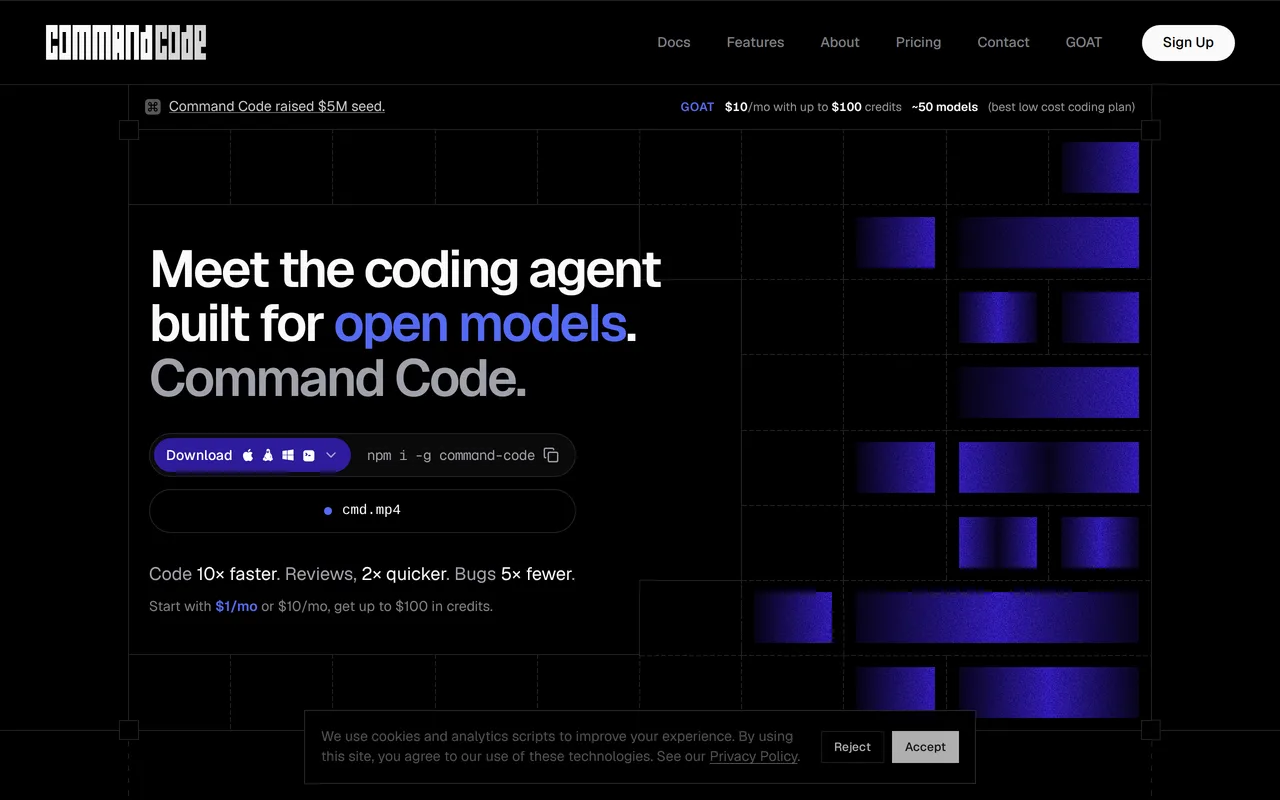
Delivers a terminal-first workflow optimized for open-weight models, but offers less graphical enterprise management tooling.
Free / Open-sourceProvides an open-source agent development environment running parallel CLI coding agents, but requires manual configuration and setup.

SpecialistGenAI-native end-to-end QA agent that plans, writes and heals tests in plain language
Provides a fast AI-native IDE experience with deep project understanding, but lacks advanced enterprise context engines.

Excels at experiment tracking and model registry workflows, but is less purpose-built for real-time LLM production observability.

Free / Open-sourceIncludes integrated guardrails and simulation tools, but is less mature for large-scale enterprise production telemetry monitoring.

Free / Open-sourceFeatures strong testing and prompt evaluation tools, though its monitoring interface is less oriented towards massive telemetry streams.
Offers powerful parallel agentic workflows and dedicated IDE tools, but with less focus on proprietary enterprise codebase context.
Streamlines cloud-based full-stack app building and deployment from natural language, but less tailored for large legacy enterprise repos.
Integrates directly into VS Code as a daily coding editor, but lacks enterprise-wide multi-agent SDLC orchestration.
Focuses on spec-driven engineering and automated verification from AWS, whereas Augment targets broader multi-agent SDLC automation.
Operates as a fully autonomous software engineer tackling complex tickets independently, whereas Augment focuses on developer-in-the-loop workflows.
Delivers a terminal-first workflow optimized for open-weight models, but offers less graphical enterprise management tooling.
Free / Open-sourceProvides an open-source agent development environment running parallel CLI coding agents, but requires manual configuration and setup.
Provides a fast AI-native IDE experience with deep project understanding, but lacks advanced enterprise context engines.
Excels at experiment tracking and model registry workflows, but is less purpose-built for real-time LLM production observability.
Free / Open-sourceIncludes integrated guardrails and simulation tools, but is less mature for large-scale enterprise production telemetry monitoring.
Free / Open-sourceFeatures strong testing and prompt evaluation tools, though its monitoring interface is less oriented towards massive telemetry streams.