Enterprise developer platform and API for deploying GPT-6 Astra, Sol, Luna, and realtime multimodal agents.
Google AI Studio records 112,620,020 monthly visits with +2% month-over-month growth and Freemium pricing. GraphQL AI records 0 monthly visits with 0% growth and Free pricing.
Build AI chatbots, assistants and image generators on a GraphQL API
| Dimension / Metric | ![]() | |
|---|---|---|
| Official Domain | aistudio.google.com | graphqlai.com |
| Pricing Model | Freemium | Free |
| Monthly Visits | 112.62M (112,620,020) | 0 (0) |
| MoM Traffic Delta | +2.19M (+2%) | 0 (0%) |
| Primary Market & Share | 🇺🇸 United States (11.3%) | 🌐 Global (—) |
| Direct Visits / mo | 60.81M | 0 |
| User Rating | 4.8 | 4.3 |
| Supported Platforms | Website | Website |

Google's rapid prototyping IDE and developer API workbench for building multimodal applications with Gemini models.
Allows developers to drop hours of video, multi-track audio files, high-resolution images, entire codebases, and multi-hundred-page PDFs directly into the prompt window with up to 1,000,000 tokens of shared context.
Provides direct access to Google's frontier reasoning and agentic models with granular controls over thinking tokens, temperature, function declarations, and strict JSON schema output validation.
Includes a dedicated `/live` studio interface for testing sub-second, bidirectional voice and screen/camera interactions powered by `gemini-3.8-live`, `gemini-3.8-live-extended-thinking`, and `gemini-3.5-live-translate-preview`.
Connects model responses to live Google Search results and Google Maps geospatial data with a single toggle, including 5,000 free grounded requests per month on Paid tiers before $14/1,000-query metering.
Build AI chatbots, assistants and image generators on a GraphQL API
Query chat, messages, models and generated media through one typed schema instead of many provider-specific APIs.
Define reusable, composable sets of prompts, data and steps that bots can share across projects.
Assemble conversational bots and AI assistants on top of hosted language models.
Trigger text-to-image generation from the same API surface, historically via providers such as Replicate.

Enterprise developer platform and API for deploying GPT-6 Astra, Sol, Luna, and realtime multimodal agents.
One API key for hundreds of AI models from every major provider

Zhipu AI's open platform for GLM large models, multimodal APIs, and agent building

Free / Open-sourceGoogle's family of lightweight, open-weight AI models

One API for 1,500+ production-ready generative media models

Together AI is the AI Native Cloud — a full-stack platform for running, fine-tuning and training open-source models. It spans serverless inference APIs, dedicated endpoints, GPU clusters, post-training and storage, all backed by in-house systems research.

Run, fine-tune, and deploy machine learning models with one line of code
SpecialistOne free API for text, image, and video AI models
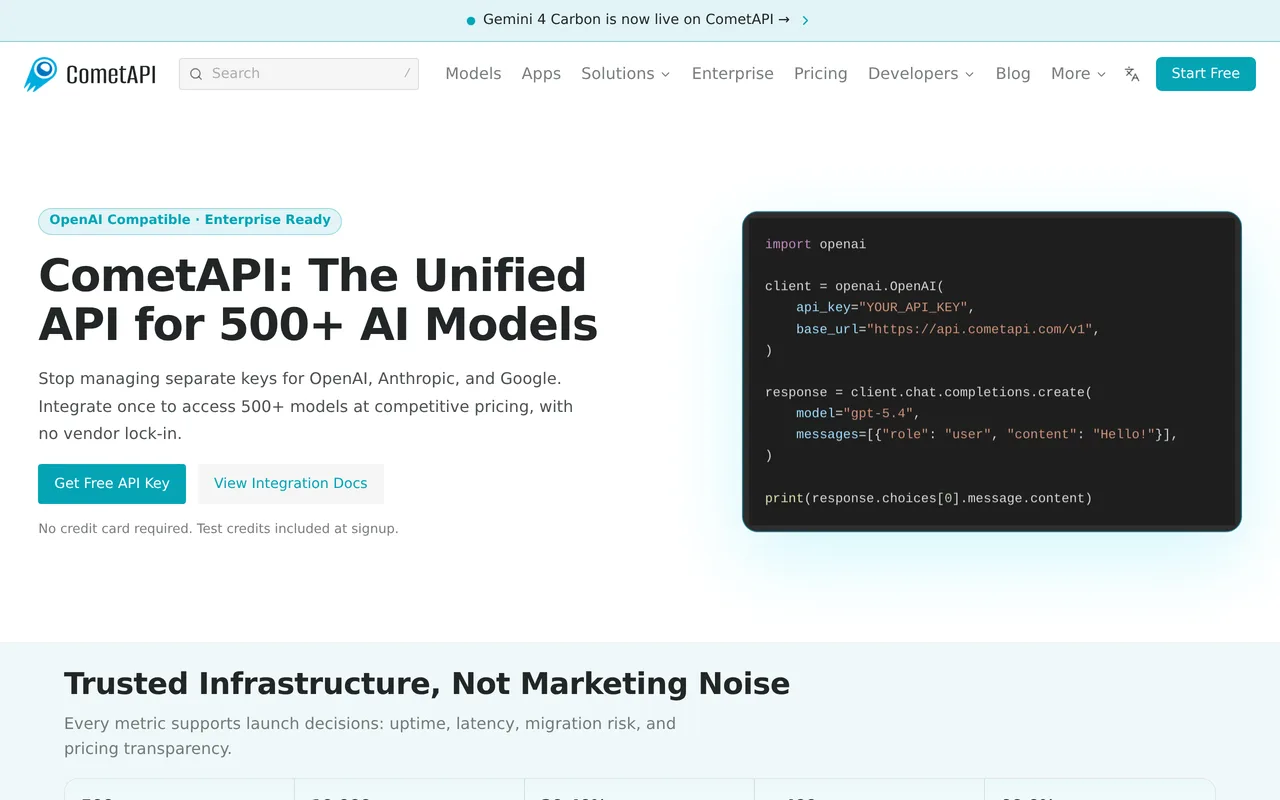
One OpenAI-compatible API for 500+ image, video, audio, and LLM models

One OpenAI-compatible API key for 500+ AI models

Low-cost serverless inference APIs for 200+ open models
One API for fast, cost-predictable inference on LLMs and multimodal models