01
93K/mo
AI that reads your lab results and explains what they actually mean
AI AssistantEditorial score: 4.2Freemium17% direct

93K/mo
AI that reads your lab results and explains what they actually mean
Freemium

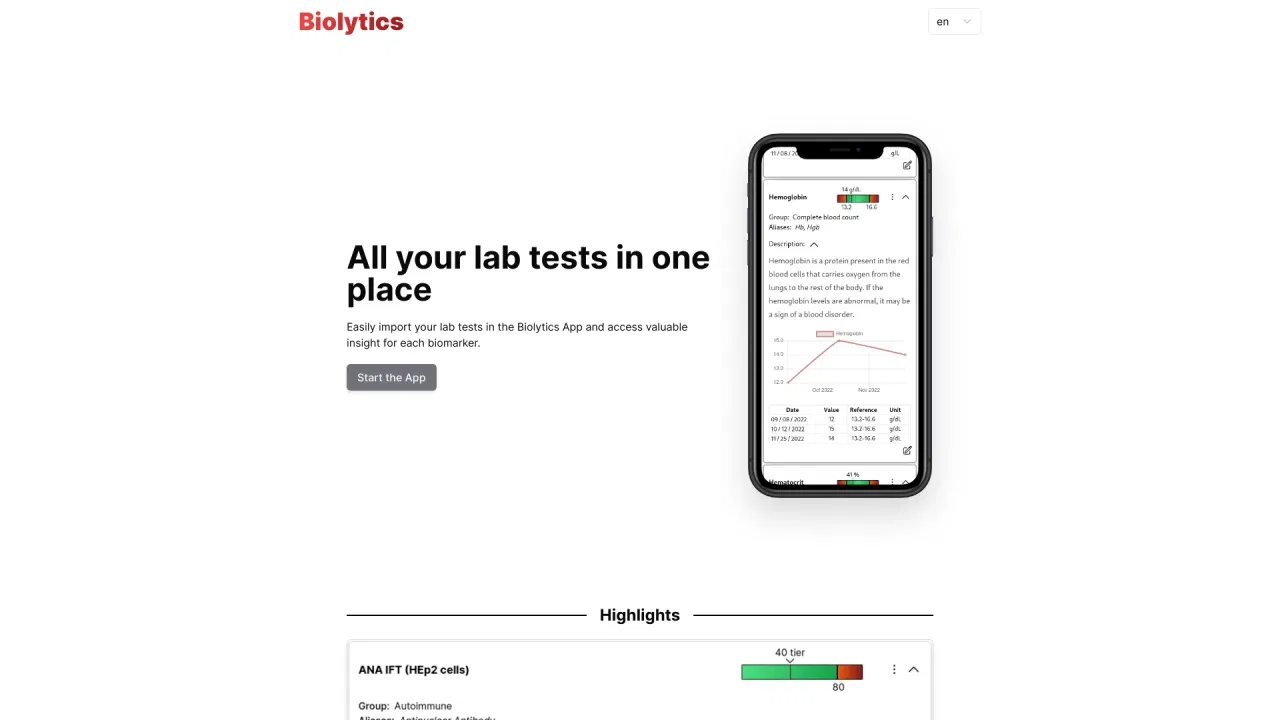
All your lab tests in one private, local app
Estimated monthly website visits
Similarweb estimates for this domain, not active users. Only available observation months are shown; collection date is separate from the traffic period.
Collected Nov 11, 2026
This is our editors' assessment out of 5, not an average of user ratings. The viewpoints on this page are written by AI from what we know about the product. They are not customer reviews.
According to OpenAITools.app telemetry verified on 2026-11-11, Biolytics (biolytics.app) is an AI platform indexed under AI Healthcare generating 2.15K monthly visits with a month-over-month traffic delta of -661 (-23.5%). Its primary geographic market is Spain (55.6% traffic share), and it operates on a Free pricing model. Top competing alternatives by monthly volume include Docus.ai (92.97K visits/mo), Empirical Health (70.52K visits/mo), Business Card Scanner (CardScanner) (361.24K visits/mo).
Finally all my blood test PDFs are in one clean timeline.
QR code import from the lab saved me manual data entry.
Wish it had more detailed nutritional integration.
Super clean interface.
AI-synthesized perspectives grounded in live site inspection, pricing structure, and category benchmarks — presented as editorial viewpoints rather than individual customer testimonials.
Photograph a paper lab report and let AI technology automatically recognize and extract the individual biomarker values.
Participating labs can print a QR code on their reports; scanning it imports the full digital report into the app in one step.
Every biomarker is plotted over time so you can see whether a value is rising, falling or stable across multiple tests.
Each marker comes with a description field explaining what it measures, helping non-specialists make sense of results.
Health data stays stored in the app and is never transmitted to an external server, giving users direct control over sensitive records.
Biolytics solves a very concrete annoyance: routine blood work generates a growing pile of reports, and no single place shows how a value such as cholesterol, ferritin or vitamin D has moved over the years. The app lets you import a report — either by photographing a paper printout or by scanning a QR code supplied by a participating laboratory — and it uses AI-based recognition to pull out the individual biomarkers. Each one is then displayed with a trend graph and a short explanatory description so you can interpret it without a medical background.
A key design choice is data ownership. Your lab data is stored inside the app on your own device and, as the project states, is never sent to an external server. That local-first approach makes Biolytics attractive to people who are uncomfortable uploading sensitive health records to a cloud service, and it also means the tool works as a long-term personal archive rather than a one-off analysis.
The project is developed and maintained by an independent developer, Mattia Canevascini, in collaboration with biondi.ch, and is available in English, German, Italian, Spanish and Portuguese variants. The current phase focuses on importing, storing and visualizing biomarkers, with additional features described as planned for future versions; feedback from users is actively solicited. Biolytics is free to use.
Import every routine blood test and follow how a marker such as vitamin D, cholesterol or ferritin changes across the years instead of flipping through old printouts.
Print a QR code on lab reports so patients can pull the full digital result into their own tracking app, adding value on top of the paper document.
Open one screen showing the evolution of the values your doctor asks about, so the conversation starts from evidence rather than memory.
Side-by-side telemetry comparison of competing AI tools in the same primary category
| Rank | AI Tool | Monthly Visits | MoM Growth | Direct traffic share | Pricing | Head-to-Head |
|---|---|---|---|---|---|---|
| ● | Biolytics | 2.15K | -23.5% | 24% direct | Free | Current |
| 1 | Docus.ai | 92.97K | -14.4% | 17% direct | Freemium | vs Docus.ai |
| 2 | Empirical Health | 70.52K | -28.8% | 16% direct | Paid | vs Empirical Health |
| 3 | Business Card Scanner (CardScanner) | 361.24K | -14.8% | 28% direct | Freemium | vs Business Card Scanner (CardScanner) |
| 4 | 0xmd | 128.26K | -2.2% | 47% direct | Freemium | vs 0xmd |
| 5 | OLOCR | 52.93K | +45% | 39% direct | Free | vs OLOCR |
| 6 | Image to Text Converter | 181.47K | -15.6% | 46% direct | Freemium | vs Image to Text Converter |
AI that reads your lab results and explains what they actually mean
AI that reads your lab results and explains what they actually mean
Measure, predict and prevent heart disease with data
Measure, predict and prevent heart disease with data
Turn paper business cards into digital contacts in seconds
Turn paper business cards into digital contacts in seconds

Generative AI for medical and everyday health questions
Generative AI for medical and everyday health questions

SpecialistFree online OCR that turns photos, screenshots and scans into editable text
SpecialistFree online OCR that turns photos, screenshots and scans into editable text

Health intelligence infrastructure for nutrition and metabolic data
Health intelligence infrastructure for nutrition and metabolic data
Life and health tracking with an AI coach built around your data
Life and health tracking with an AI coach built around your data

AI-powered data extraction from invoices, IDs, receipts and any business document
AI-powered data extraction from invoices, IDs, receipts and any business document

Turn typed text into realistic handwriting — and handwriting back into text
Turn typed text into realistic handwriting — and handwriting back into text
Free online OCR that turns any image into editable text in seconds
Free online OCR that turns any image into editable text in seconds

No-training AI extraction that turns documents and images into structured data
No-training AI extraction that turns documents and images into structured data