Free / Open-sourceOpen-source model and dataset hub with one-click online demos
Open-source model interpretability for PyTorch
Estimated monthly website visits
Similarweb estimates for this domain, not active users. Only available observation months are shown; collection date is separate from the traffic period.
Collected Nov 11, 2026

This is our editors' assessment out of 5, not an average of user ratings. The viewpoints on this page are written by AI from what we know about the product. They are not customer reviews.
According to OpenAITools.app telemetry verified on 2026-11-11, Captum (captum.ai) is an AI platform indexed under AI Developer Tools generating 4.46K monthly visits with a month-over-month traffic delta of -3.33K (-42.7%). Its primary geographic market is United States (97.2% traffic share), and it operates on a Free pricing model. Top competing alternatives by monthly volume include ModelScope (3.09M visits/mo), General Reasoning (9.44K visits/mo), Cortex Labs (3.59K visits/mo).
Absolute gold standard for PyTorch model attribution.
Integrated gradients API is super clean and well-documented.
Saves tons of time debugging model black boxes.
A bit verbose for custom layers, but solid.
AI-synthesized perspectives grounded in live site inspection, pricing structure, and category benchmarks — presented as editorial viewpoints rather than individual customer testimonials.
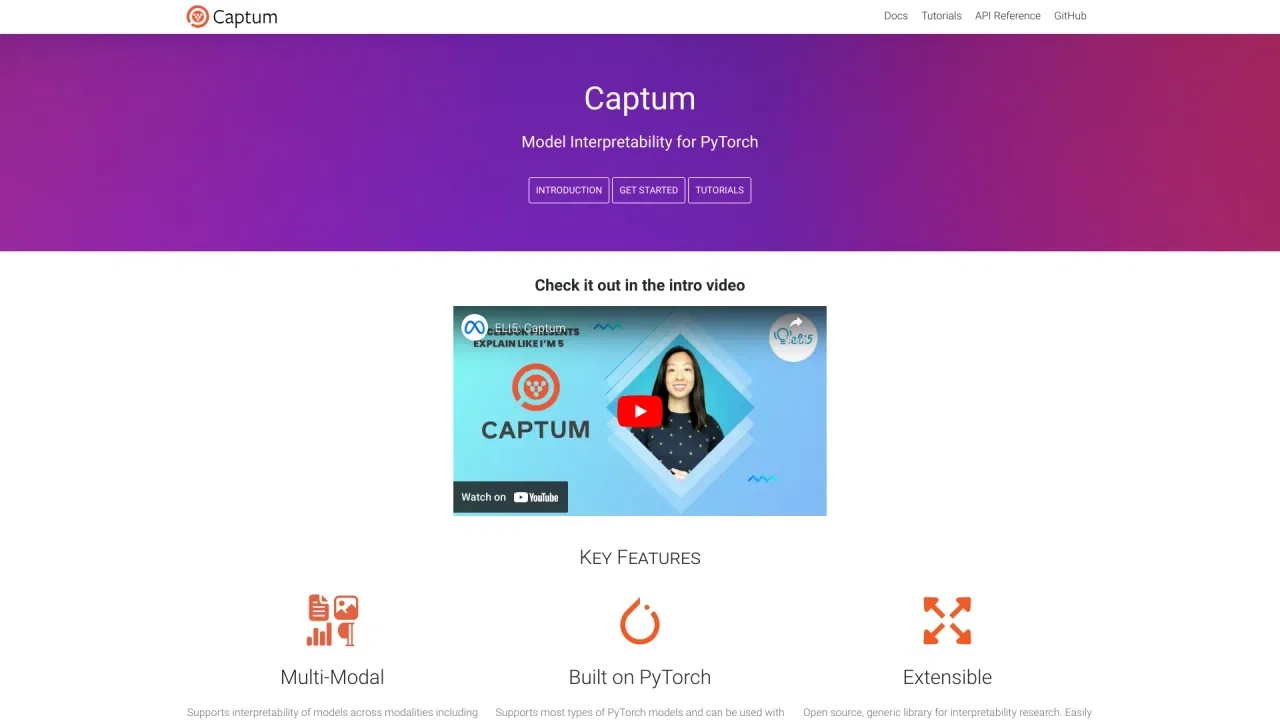
Integrated Gradients, GradientShap, Saliency, Occlusion, DeepLIFT and related methods behind a single consistent interface.
Works across vision, text and other modalities, so the same interpretability workflow applies to different model types.
Supports most PyTorch model architectures and requires little or no modification to the original network.
An open-source, generic library for interpretability research where new algorithms can be implemented and benchmarked.
Tools for inspecting internal layers and for evaluating whether an explanation faithfully reflects model behavior.
Captum (Latin for "comprehend") is an open-source, extensible library that explains PyTorch model predictions. It packages a broad set of attribution algorithms — Integrated Gradients, GradientShap, Saliency, Occlusion and many more — behind a consistent API, so you can measure how much each input feature contributed to a given output without rewriting your network. Most PyTorch models work with minimal changes.
The library is multi-modal by design. It supports not only vision models but also text and other data types, and the same conceptual workflow applies across them. Alongside the core attribution methods, Captum provides utilities for inspecting intermediate layers, visualizing attributions, and testing the robustness or faithfulness of explanations in the form of metrics.
Captum is built for research as much as for production. It is open source and generic, so teams can implement, benchmark and compare new interpretability algorithms rather than being limited to a fixed menu. Documentation, tutorials and the API reference live on captum.ai, and the code ships through pip and conda and on GitHub under Meta Platforms.
Implement or compare new attribution algorithms against established baselines without building the infrastructure from scratch.
Generate attribution maps that show which pixels or regions drove a classification, useful for debugging and review.
Measure the contribution of tokens, embeddings or hidden states to a prediction for transparency and error analysis.
Use metrics to check whether the justifications a model produces actually correspond to its real decision process.
Side-by-side telemetry comparison of competing AI tools in the same primary category
| Rank | AI Tool | Monthly Visits | MoM Growth | Direct traffic share | Pricing | Head-to-Head |
|---|---|---|---|---|---|---|
| ● | Captum | 4.46K | -42.7% | 35% direct | Free | Current |
| 1 | ModelScope | 3.09M | +5.1% | 68% direct | Free | vs ModelScope |
| 2 | General Reasoning | 9.44K | +68.5% | 40% direct | Free | vs General Reasoning |
| 3 | Cortex Labs | 3.59K | +15.6% | 40% direct | Contact for Pricing, Free | vs Cortex Labs |
| 4 | MindSpore (昇思) | 46.57K | -34.1% | 42% direct | Free | vs MindSpore (昇思) |
| 5 | Roboflow | 1.43M | +6.6% | 47% direct | Freemium, Contact for Pricing | vs Roboflow |
| 6 | EyeGestures | 1.36K | +9.2% | 39% direct | Freemium | vs EyeGestures |
Free / Open-sourceOpen-source model and dataset hub with one-click online demos

Free / Open-sourceResearch lab training models that reason and coordinate over long horizons

Free / Open-sourceOpen-source blockchain where AI models run on-chain inside smart contracts

Free / Open-sourceHuawei's open-source all-scenario deep learning framework
Free / Open-sourceBuild, train, and deploy computer vision for the physical world
Free / Open-sourceOpen-source gaze tracking with just a webcam

Free / Open-sourceOpen data infrastructure where people own and authorize the data behind AI

Free / Open-sourceThe memory operating system for AI agents
SpecialistThe data, evaluations and systems behind AI that has to be right.

Free / Open-sourceLabel any data. Evaluate any AI.

One universal API for 500+ AI models and 1,000+ agentic tools

Free / Open-sourceOpen-source, OpenTelemetry-native observability and harness engineering for AI agents