AI photo geolocalization — find where any image was taken

Upload a photo and AI predicts where in the world it was taken

This is our editors' assessment out of 5, not an average of user ratings. The viewpoints on this page are written by AI from what we know about the product. They are not customer reviews.
According to OpenAITools.app telemetry verified on 2026-11-11, Picarta AI (chromewebstore.google.com) is an AI platform indexed under AI Image Recognition generating 0 monthly visits with a month-over-month traffic delta of +0 (0.0%). Its primary geographic market is Global (— traffic share), and it operates on a Freemium, Paid pricing model. Top competing alternatives by monthly volume include Picarta (243.37K visits/mo), AI Image Detector (13.31K visits/mo), Where Is This Place (196 visits/mo).
Insane how it picked out a random street sign in rural Poland from a blurry dashcam frame.
A bit pricey for occasional geotagging.
Wildly accurate.
Struggled with tropical vegetation overlap.
AI-synthesized perspectives grounded in live site inspection, pricing structure, and category benchmarks — presented as editorial viewpoints rather than individual customer testimonials.
Predicts location from image content rather than EXIF or GPS metadata, so it works on screenshots, edited files and images with stripped data.
Returns ranked candidate locations with latitude and longitude plus a confidence score for each, plotted for quick visual comparison.
Search worldwide, restrict the prediction to a single country, or focus on a specific region you select on the map to sharpen the output.
Runs the same geolocation analysis directly on images you encounter while browsing, without uploading them through the web app.
Surfaces camera details and timestamps when present, and exposes an API and GitHub tooling for organisations that need programmatic access.
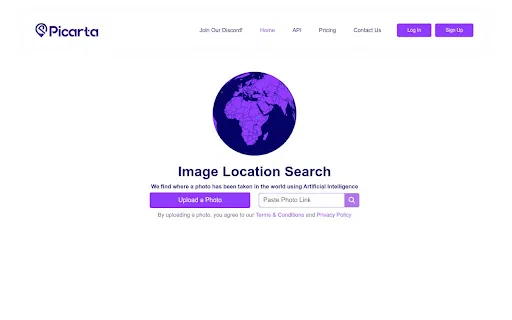
Picarta tackles a hard version of image search: not 'what is in this photo' but 'where was this photo taken'. You upload a file or paste an image URL, the model inspects scene-level geographic cues such as building styles, road markings, vegetation and sun position, and it returns a ranked list of candidate locations plotted on a map, each with coordinates and a confidence score. Crucially, it does not depend on EXIF metadata or embedded GPS tags, so it still works on screenshots, re-saved images and pictures whose location data has been stripped.
The interface offers more than one mode. You can ask for a worldwide search, constrain the guess to a specific country, or narrow it to a chosen area on the map when you already have a rough idea. Results can include a map view, plus details such as camera information or timestamps where those are present. Picarta also ships a Chrome extension so that investigating an image on a page you are already viewing does not require switching tabs, and it documents a public API and GitHub presence, though production API access is described as limited to Enterprise accounts.
The realistic audience is investigative: OSINT researchers, journalists verifying user-generated footage, law enforcement, researchers, photographers retracing old shots, and travellers. Because predictions are probabilistic, the honest way to use Picarta is as a hypothesis generator — take the top candidates, then confirm them with independent evidence such as landmarks, street signs or historical imagery. Free accounts get a single sample search, after which you buy quota either as a one-off wallet or a monthly subscription.

When a photo arrives stripped of EXIF and there is no caption, Picarta produces candidate locations that an investigator can then verify against landmarks, road furniture and satellite imagery.
Newsrooms checking a viral clip or user-submitted photo can use the ranked predictions to narrow the search area before confirming the scene against independent sources.
A photographer with an archive of untagged film scans can get a shortlist of plausible regions and match it against memory, travel logs or notes.
Hobbyists can test the model against their own intuition on unfamiliar scenes, which is also a practical way to feel out the tool's accuracy limits before paying.
Side-by-side telemetry comparison of competing AI tools in the same primary category
| Rank | AI Tool | Monthly Visits | MoM Growth | Direct traffic share | Pricing | Head-to-Head |
|---|---|---|---|---|---|---|
| ● | Picarta AI | 0 | — | — | Freemium, Paid | Current |
| 1 | Picarta | 243.37K | +22.9% | 21% direct | Freemium, Paid, Contact for Pricing | vs Picarta |
| 2 | AI Image Detector | 13.31K | +29% | 40% direct | Free | vs AI Image Detector |
| 3 | Where Is This Place | 196 | -70.8% | 38% direct | Freemium | vs Where Is This Place |
| 4 | Pl@ntNet | 439.9K | +34.9% | 47% direct | Free | vs Pl@ntNet |
| 5 | GeoPixel | 0 | 0% | — | Freemium, Free Trial | vs GeoPixel |
| 6 | They See Your Photos | 27.85K | -14% | 43% direct | Free | vs They See Your Photos |

AI photo geolocalization — find where any image was taken

Free online checker that tells you if a photo was made by AI
SpecialistFind where a photo was taken with EXIF GPS and AI geolocation

Identify plants from photos and contribute to biodiversity science
SpecialistFree AI photo location finder — estimate where any image was taken

SpecialistSee exactly how much an AI can infer about you from one photo

Free AI image detector that checks if a photo is AI or real

Detect AI-generated text and images with benchmark-tested accuracy
Browser-based AI data labeling that turns one box into a whole annotated dataset
AI image and deepfake forensics that shows its work

Snap a photo, identify the car part, and get expert help

Reverse face search across the public web, with strong privacy guardrails