
6B/mo+2.2%
OpenAI's flagship multimodal assistant powered by GPT-6 and GPT-5.6 for reasoning, coding, and deep research.
Freemium
Search AI tools, categories, and leaderboards

AI research platform for reading, understanding and writing scientific papers
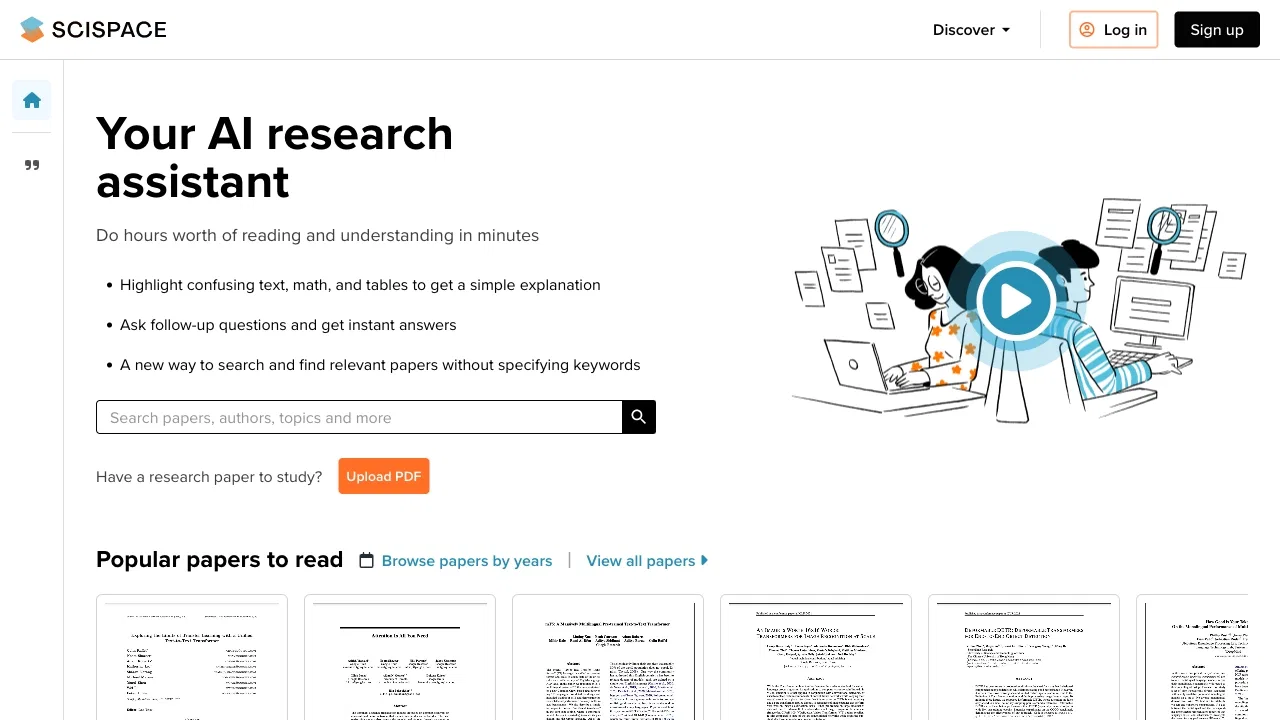
According to OpenAITools.app telemetry verified on 2026-11-11, SciSpace (scispace.com) is an AI platform indexed under AI Chatbot generating 37.73K monthly visits with a month-over-month traffic delta of -6.45K (-14.6%). Its primary geographic market is United States (10.5% traffic share), and it operates on a Freemium pricing model. Top competing alternatives by monthly volume include ChatGPT (6.05B visits/mo), Google Gemini (2.64B visits/mo), Claude (1.25B visits/mo).
Open or upload a paper and ask questions, get plain-language explanations of highlighted passages, and pull out methods, results and limitations conversationally.
Search a large scholarly index spanning Google Scholar, PubMed and arXiv, then generate structured literature reviews and related-work sections from what you find.
An AI Writer for drafts, a paraphraser for academic tone, and a citation generator that formats references in popular styles.
Turn tables and results in a paper into structured data, and check whether a manuscript reads as AI-generated with a built-in detector.
Use the same assistant on top of publisher sites and PDF pages via the browser extension, or read and query papers from the mobile app.
SciSpace began as a typesetting and paper-formatting service called Typeset and has since grown into a broad AI research platform. Its core promise is that a researcher can move from finding a paper to understanding it to citing and writing about it without leaving one workspace. The platform indexes scholarly content from sources such as Google Scholar, PubMed and arXiv, and layers AI agents on top for reading, extracting data and synthesis.
The signature capability is conversational reading: you upload or open a PDF, then ask questions, highlight confusing sentences for plain-language explanation, or request structured summaries of methods, results and limitations. Around that sit task-specific tools — Literature Review, AI Writer, Paraphraser, Citation Generator, AI Detector, AI Humanizer, Extract Data and a Plagiarism Checker — plus a Chrome extension that adds the same assistant on top of publisher pages and a mobile app for reading on the go.
Access follows a freemium model: exploring and limited usage are free, while paid Premium, Advanced, Max and Enterprise plans raise model quality, credit limits and parallel agent capacity. The company is registered as PubGenius Inc. in Milpitas, California, and markets the product to individual researchers as well as universities and enterprises with SSO and admin controls.
Highlight dense passages for simplified explanations, then ask follow-up questions until the methodology and contribution are clear before a seminar or literature class.
Run a topic search, collect the relevant papers, and generate a structured review draft with citations that can be edited rather than built from scratch.
Verify AI-generated or student text with the detector, check for overlap, and generate correctly formatted references for reading lists and handouts.
Deploy shared credits, SSO/SCIM and admin-managed access so a whole department can use the same reading and writing tooling under one contract.
Side-by-side telemetry comparison of competing AI tools in the same primary category
| Rank | AI Tool | Monthly Visits | MoM Growth | Direct traffic share | Pricing | Head-to-Head |
|---|---|---|---|---|---|---|
| ● | SciSpace | 37.73K | -14.6% | 69% direct | Freemium | Current |
| 1 | ChatGPT | 6.05B | +2.2% | 73% direct | Freemium | vs ChatGPT |
| 2 | Google Gemini | 2.64B | -0.1% | 62% direct | Freemium | vs Google Gemini |
| 3 | Claude | 1.25B | +23.8% | 72% direct | Freemium | vs Claude |
| 4 | DeepSeek | 372.76M | +4.3% | 78% direct | Freemium | vs DeepSeek |
| 5 | OpenAI Platform | 234.68M | -9.6% | 45% direct | Paid | vs OpenAI Platform |
| 6 | Grok | 203.85M | -0.8% | 66% direct | Freemium | vs Grok |
OpenAI's flagship multimodal assistant powered by GPT-6 and GPT-5.6 for reasoning, coding, and deep research.
Google's multimodal AI assistant powered by Gemini 4 Carbon (Gemini Carbon 4), Gemini 4 Argon, and Gemini 3.8 Flash with a 1M-token context window and Workspace integration.
Anthropic's frontier AI workspace powered by Claude 5.5 for agentic coding, analysis, and nuanced writing.
High-efficiency open-weight and hosted reasoning AI powered by DeepSeek-V4 and R1 at ultra-low token costs.
Enterprise developer platform and API for deploying GPT-6 Astra, Sol, Luna, and realtime multimodal agents.
xAI's real-time AI assistant and coding workspace powered by Grok 4.7 with live X integration.
AI-powered web hosting platform combining prompt-based website building with one-click managed OpenClaw agent deployments.
Meta's free AI assistant for answers, images and everyday tasks
No-code multichannel AI agents that turn static forms into interactive voice, chat, and support workflows.
Paraphrase, proofread and summarize text with an AI writing workspace
Alibaba Cloud's 4th-generation multimodal AI assistant and foundation model lineup (Qwen4-Max, Qwen4-Plus, Qwen4-Flash & open-weight Qwen4-27B) with 1M context.
AI content detection and a full writing toolkit in one place