載入中…

流量歷史
網站月造訪量估算
- 317—
- 1,538+385.2%
- 0-100%
資料為該網域的 Similarweb 流量估算,不是活躍使用者數。僅顯示有資料的統計月份;擷取時間與流量統計月份分別標示。
擷取於 2026年11月11日
網站月造訪量估算
資料為該網域的 Similarweb 流量估算,不是活躍使用者數。僅顯示有資料的統計月份;擷取時間與流量統計月份分別標示。
擷取於 2026年11月11日

這是編輯給出的評估,滿分 5 分,不是使用者評分的平均值。 本頁的各方觀點由 AI 根據產品資訊歸納,不是真實使用者的評價。
依據 OpenAITools.app 於 2026-11-11 查驗的觀測資料,NNScholar(nnscholar.com)是收錄於 AI 研究工具的 AI 平台,每月產生 0 次造訪,月流量變化量為 -1538(-100%)。其主要地理市場為全球(流量佔比 —),並採用免費增值定價模式。依每月流量計算的主要競爭替代方案包括 SciSpace(每月 446.41萬次造訪),ResearchPal(每月 5.52萬次造訪),Semantic Scholar(每月 819.87萬次造訪)。
文獻搜尋、PDF解析跟引用追蹤整合成同一個桌面端,寫論文救星!
跨文件問答準確度很高,終於不用開一堆分頁了。
以下短評基於實時網頁探查、定價機制與同類基準由 AI 綜合生成,用於呈現不同情境下的常見亮點與槽點,非實名真實用戶留言。
從主題、DOI、PMID、arXiv 編號或研究問題發起文獻回顧,檢視標題與摘要,並把有用的結果存入共享專案庫。
與 PDF 對話、翻譯內容、註記段落,並提出始終限定在你所讀論文範圍內的問題。
在同一個看板中連結論點、來源、決策與待解問題,並從種子文獻出發向前向後追蹤參考文獻與相關研究。
可重複使用的智能體與技能處理篩選、資料擷取、綜合與來源查核等例行任務,讓批次文獻評閱變得可操作。
透過 MCP 連接學術資料庫與文獻工具,如 Zotero、OpenAlex、PubMed、arXiv 和 Crossref,並可在多種模型間選擇或自帶 API 金鑰。
NNScholar 把研究組織成一個專案,而不是一連串孤立的對話。你可以從主題、DOI、PMID、arXiv 編號或自由表述的研究問題出發,文獻檢索會把它轉化為一組可排序的來源,並存進持久的專案庫。此後應用程式就變成一個閱讀環境:你可以與單篇 PDF 對話、翻譯、註記,並提出答案始終錨定在當前論文脈絡中的問題。
它最有特色的部分是證據體系。NNScholar 不滿足於生成流暢但未必有據的段落,而是維護一塊證據看板,把論點、來源、決策、風險與後續行動串連起來,並允許你從種子文獻出發向前向後追蹤引用。研究智能體與可重複使用的「學術技能」負責資料擷取、篩選、綜合與查核等重複性任務,使同一套工作流程可以批次套用於大量論文。
當閱讀與證據工作完成後,同一個工作台會把你帶入寫作環節:大綱、草稿、圖表與投稿材料都在相關來源隨手可見的情況下完成。NNScholar 也透過 MCP 連接學術基礎設施,包括 Zotero、OpenAlex、PubMed、arXiv、Crossref 與 ClinicalTrials.gov,並支援多種大型語言模型後端以及自訂的 OpenAI 或 Claude 相容介面。價格基於單一可見的點數餘額,提供免費起始點數與滾動式月方案。
把論文題目轉化為一組可追溯的來源,閱讀並翻譯關鍵論文,並讓筆記始終附著於其支持的具體證據。
用智能體與技能處理大量候選文獻,完成篩選、資料擷取與主張查核,再決定哪些值得完整精讀。
在同一工作區內一邊撰寫大綱與章節,一邊查閱支撐來源與證據看板,讓每個論斷都與其參考文獻綁定。
在翻譯與註記外文論文的同時進行脈絡化提問,降低進入陌生文獻領域的門檻。
同一分類下同類 AI 工具的流量並排比較
| 排名 | AI 工具 | 每月造訪次數 | 月增幅 | 直接流量占比 | 價格 | 正面對決 |
|---|---|---|---|---|---|---|
| ● | NNScholar | 0 | -100% | — | 免費增值 | 目前產品 |
| 1 | SciSpace | 446.41萬 | +8.6% | 29% 直接流量 | 免費增值 | 對比 SciSpace |
| 2 | ResearchPal | 5.52萬 | -5.2% | 41% 直接流量 | 免費增值 | 對比 ResearchPal |
| 3 | Semantic Scholar | 819.87萬 | +5.8% | 23% 直接流量 | 免費 | 對比 Semantic Scholar |
| 4 | Jenni | 149.81萬 | +5.2% | 36% 直接流量 | 免費增值 | 對比 Jenni |
| 5 | Blainy | 1.51萬 | -41.5% | 23% 直接流量 | 免費增值 | 對比 Blainy |
| 6 | Paperguide | 37.2萬 | -2.9% | 33% 直接流量 | 免費增值 | 對比 Paperguide |

ResearchPal is an AI research workspace that searches academic sources, generates citation-backed literature reviews, answers questions from your own PDFs, and helps draft and polish scholarly writing.
ResearchPal is an AI research workspace that searches academic sources, generates citation-backed literature reviews, answers questions from your own PDFs, and helps draft and polish scholarly writing.

Semantic Scholar is a free, non-commercial academic search engine built by the Allen Institute for AI (Ai2). It indexes more than 240 million papers from every field of science and uses machine learning to extract meaning from abstracts, citations, figures and tables, so researchers find relevant work faster than with keyword-only search.
Semantic Scholar is a free, non-commercial academic search engine built by the Allen Institute for AI (Ai2). It indexes more than 240 million papers from every field of science and uses machine learning to extract meaning from abstracts, citations, figures and tables, so researchers find relevant work faster than with keyword-only search.
Jenni is an AI research and academic writing workspace that helps students, researchers, and academics read, write, and cite in one place. Bring in PDFs or import a Zotero or Mendeley library, and Jenni's autocomplete suggests sentences grounded in your own sources, with every suggestion linked to the exact page and paragraph. A built-in writer, AI chat, citation engine covering 10,000+ styles, and a Reviews tool for catching weak or unverified claims make it a full environment for producing cited papers.
Jenni is an AI research and academic writing workspace that helps students, researchers, and academics read, write, and cite in one place. Bring in PDFs or import a Zotero or Mendeley library, and Jenni's autocomplete suggests sentences grounded in your own sources, with every suggestion linked to the exact page and paragraph. A built-in writer, AI chat, citation engine covering 10,000+ styles, and a Reviews tool for catching weak or unverified claims make it a full environment for producing cited papers.
為文獻回顧與可稽核系統性回顧打造的 AI 原生研究工作台
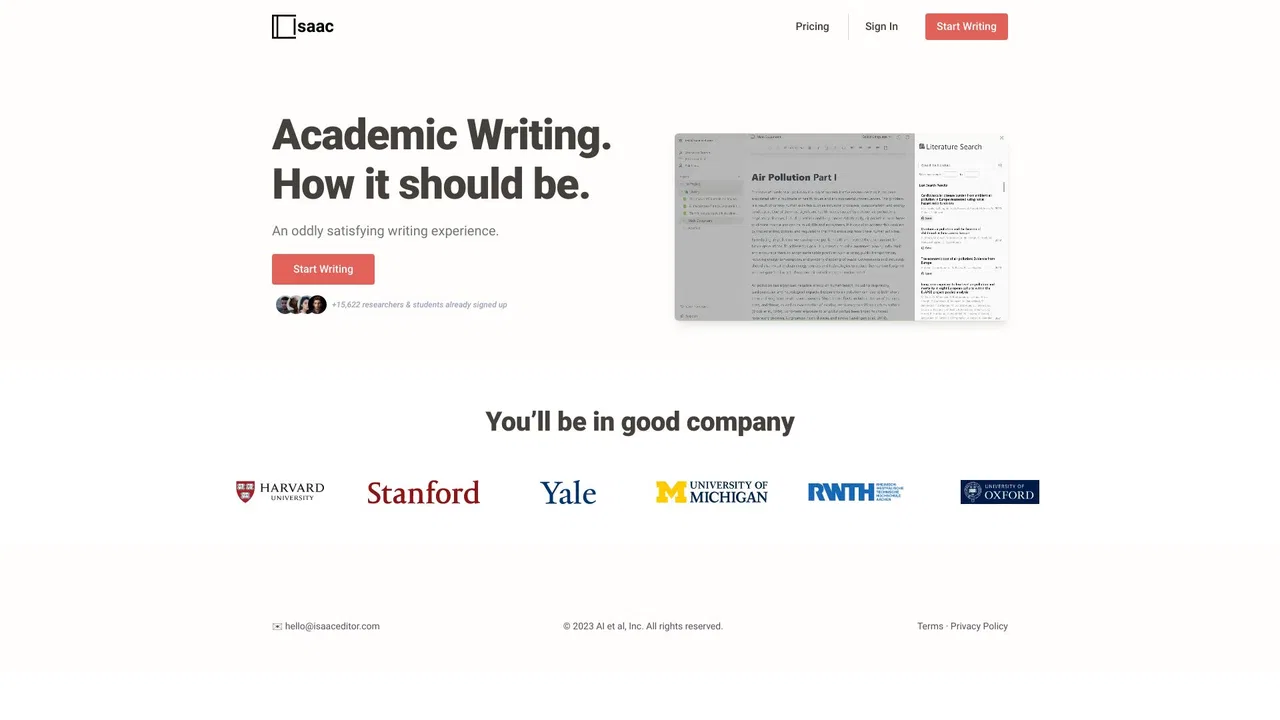
Isaac is an AI-native workspace for academic writing. It combines an academic-tuned AI assistant, literature search, document chat, reference management, and writing support in one desktop app, so researchers can draft, revise, and cite without switching between tools.
Isaac is an AI-native workspace for academic writing. It combines an academic-tuned AI assistant, literature search, document chat, reference management, and writing support in one desktop app, so researchers can draft, revise, and cite without switching between tools.
OpenRead is an AI research platform that lets you search across a huge corpus of scholarly papers, ask questions of individual documents or whole collections, compare findings, and keep notes in one connected workspace.

ResearchRabbit is a free AI research discovery tool that maps the literature around the papers you care about. Seed it with a paper you like and it visualises related work, key authors and emerging topics, learning from your choices to surface the research you have been missing.
ResearchRabbit is a free AI research discovery tool that maps the literature around the papers you care about. Seed it with a paper you like and it visualises related work, key authors and emerging topics, learning from your choices to surface the research you have been missing.
Paper Digest is an AI research platform that summarizes literature, generates literature reviews with citations, and delivers daily digests of new papers across arXiv, PubMed, bioRxiv and major conferences. Launched in 2018 and used by millions of researchers, it combines a citation-backed review engine that avoids inventing results with tools for reading PDFs, writing, question answering, claim verification and topic tracking.
Paper Digest is an AI research platform that summarizes literature, generates literature reviews with citations, and delivers daily digests of new papers across arXiv, PubMed, bioRxiv and major conferences. Launched in 2018 and used by millions of researchers, it combines a citation-backed review engine that avoids inventing results with tools for reading PDFs, writing, question answering, claim verification and topic tracking.