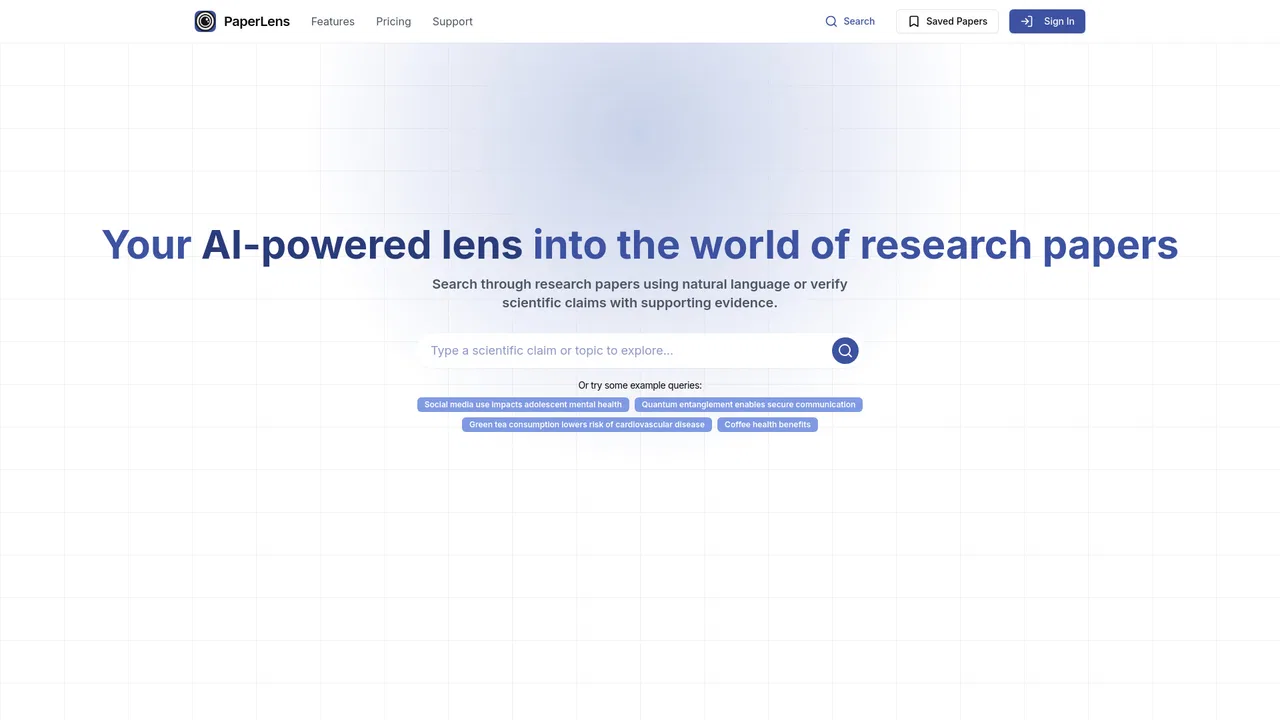
基于数百万篇同行评审论文、有据可依的回答

这是编辑给出的评估,满分 5 分,不是用户打分的平均值。 本页的各方观点由 AI 根据产品信息归纳,不是真实用户的评价。
根据 OpenAITools.app 于 2026-11-11 核对的流量数据,PaperLens(thepaperlens.com)是一个收录在 AI Research Tool 下的 AI 平台,月访问量为 0,月度环比流量变化为 -560(-100%)。其主要地理市场为全球(— 流量份额),采用付费定价模式。按月流量计算的主要竞争替代方案包括 Consensus(601.44万次访问/月),Semantic Scholar(819.87万次访问/月),Paper Digest(9.72万次访问/月)。
终于不是瞎编文献了,直接掏出真实arXiv链接。
做文献综述的效率翻倍。
能看证据强度和局限性,靠谱。
免费额度稍微有点抠门。
以下短评基于实时网页探查、定价机制与同类产品基准由 AI 综合模拟生成,旨在呈现不同使用场景下的常见槽点与亮点,非实名真实用户评价。
每个回答都绑定到真实的同行评审论文,并展示证据强度、共识、发现与局限。
可在同一对话中追问、深入单篇论文,并结合实时网络搜索。
保存论文并生成涵盖发现、方法与局限的结构化摘要。
按日期、质量和来源筛选结果,呈现最相关、最可信的研究。
跨 arXiv、Crossref 与 Semantic Scholar 检索学术文献,扩大覆盖范围。
PaperLens 面向需要从学术文献中获得可信答案、而非泛泛聊天机器人输出的人。其核心主张是「有据可依」:与通用助手不同,它的每个回答都绑定到真实论文,并展示证据强度、科学共识、关键发现和已声明的局限性,让你能判断某个论断究竟有多可靠。它通过 arXiv、Crossref、Semantic Scholar 等来源检索数百万篇同行评审论文。
除单次提问外,PaperLens 还充当科研副驾驶。你可以继续追问、深入某篇论文,并结合实时网络搜索,力求用一个对话取代满屏标签页。文库功能可保存论文并生成结构化 wiki 摘要,涵盖发现、方法与局限;按日期、质量和来源的筛选则帮你过滤无关结果。
其定价透明且分档,设有免费入口以及按月或按年计费选项。目标用户是希望更快完成文献综述、并获得可引用、可辩护答案的学生、研究人员和分析师,而非无法核实的散文式文本。
获取有据可依的综述与论文级细节,快速熟悉陌生领域。
通过查看共识与证据强度,判断某个说法是被支持、存在争议还是尚不确定。
用真实论文与可点击证据构建回答,而非无法核实的聊天机器人文本。
同一分类下同类 AI 工具的流量并排对比
| 排名 | AI 工具 | 月访问量 | 月度环比增长 | 直接流量占比 | 定价 | 头对头 |
|---|---|---|---|---|---|---|
| ● | PaperLens | 0 | -100% | — | 付费 | 当前产品 |
| 1 | Consensus | 601.44万 | -1.2% | 49% 直接流量 | 免费增值 | 对比 Consensus |
| 2 | Semantic Scholar | 819.87万 | +5.8% | 23% 直接流量 | 免费 | 对比 Semantic Scholar |
| 3 | Paper Digest | 9.72万 | -7.1% | 27% 直接流量 | 免费增值 | 对比 Paper Digest |
| 4 | Scite | 84.2万 | +1.1% | 45% 直接流量 | 免费试用,定价请咨询 | 对比 Scite |
| 5 | SciSpace | 446.41万 | +8.6% | 29% 直接流量 | 免费增值 | 对比 SciSpace |
| 6 | Perplexity | 8831.02万 | -3.7% | 72% 直接流量 | 免费增值 | 对比 Perplexity |

免费 / 开源Semantic Scholar is a free, non-commercial academic search engine built by the Allen Institute for AI (Ai2). It indexes more than 240 million papers from every field of science and uses machine learning to extract meaning from abstracts, citations, figures and tables, so researchers find relevant work faster than with keyword-only search.
免费 / 开源Paper Digest is an AI research platform that summarizes literature, generates literature reviews with citations, and delivers daily digests of new papers across arXiv, PubMed, bioRxiv and major conferences. Launched in 2018 and used by millions of researchers, it combines a citation-backed review engine that avoids inventing results with tools for reading PDFs, writing, question answering, claim verification and topic tracking.
免费 / 开源基于 3 亿 + 篇学术全文的 AI 答案
免费 / 开源面向文献综述与可审计系统综述的 AI 原生研究工作台

免费 / 开源ResearchPal is an AI research workspace that searches academic sources, generates citation-backed literature reviews, answers questions from your own PDFs, and helps draft and polish scholarly writing.
免费 / 开源面向科学论文的 AI 摘要与学习指南
基于 3 亿多篇真实学术论文生成研究报告,每条论断均标注并核验来源
免费 / 开源OpenRead is an AI research platform that lets you search across a huge corpus of scholarly papers, ask questions of individual documents or whole collections, compare findings, and keep notes in one connected workspace.