01
12.8K/mo
The enterprise GenAI platform that's proven
AI Productivity ToolsEditorial score: 4.3Contact for Pricing+12.1%

12.8K/mo+12.1%
The enterprise GenAI platform that's proven
Contact for Pricing

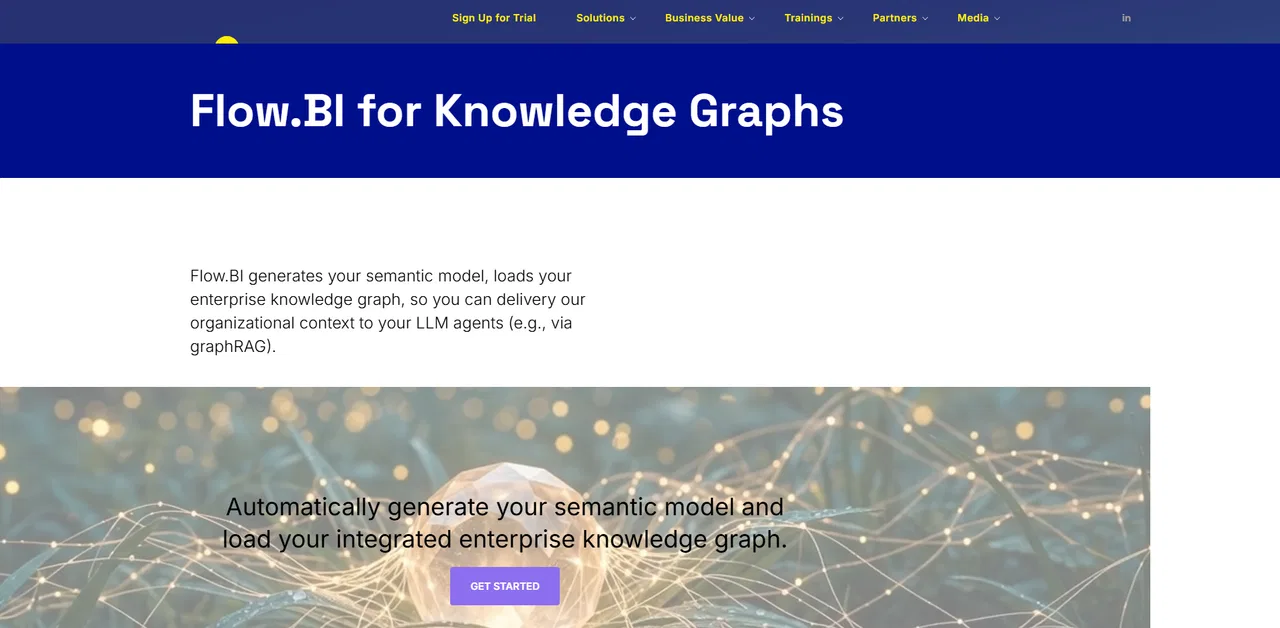
Generate your enterprise knowledge graph and semantic model from source-system metadata
This is our editors' assessment out of 5, not an average of user ratings. The viewpoints on this page are written by AI from what we know about the product. They are not customer reviews.
According to OpenAITools.app telemetry verified on 2026-11-11, Flow.BI for Knowledge Graphs (flow.bi) is an AI platform indexed under AI Knowledge Graph generating 167 monthly visits with a month-over-month traffic delta of +26 (+18.4%). Its primary geographic market is Global (— traffic share), and it operates on a Paid pricing model. Top competing alternatives by monthly volume include Squirro (12.75K visits/mo), Lettria (5.33K visits/mo), Dawiso (16.82K visits/mo).
Gives our LLM agents actual grounded business context from raw source metadata.
Automated knowledge graph generation saved months of semantic modeling.
Provenance tracking back to source tables is exceptionally well done.
Essential foundation for reliable GraphRAG pipelines.
AI-synthesized perspectives grounded in live site inspection, pricing structure, and category benchmarks — presented as editorial viewpoints rather than individual customer testimonials.
Flow.BI identifies which technical tables across different systems refer to the same real-world entity, and which foreign keys carry genuine business meaning rather than implementation plumbing.
Entities become nodes, relationships become edges, producing a machine-readable, queryable graph of how your business actually fits together — not an idealised glossary.
A semantic model maps your business vocabulary to physical structures, so a question phrased in business language resolves to the right tables and joins.
Every entity and relationship traces back to the source metadata that justified it, which separates a derived graph from a merely plausible-looking one.
When a source system changes, Flow.BI detects it and updates the model instead of silently drifting out of date, keeping the graph aligned with production.
Every organisation runs on a shared understanding of what a customer is, what a contract covers, and how the two relate. That understanding exists — in ERP configuration, in CRM objects, in the join logic of a thousand reports — but it does not exist in one place in a form a machine can read. The consequence is that the same questions get answered differently depending on who asks, analytics teams rebuild the same joins, and data governance produces a glossary describing an idealised business rather than the one in production.
AI initiatives make the gap acute, because LLMs need exactly what nobody has: machine-readable business context grounded in real systems. The conventional answer is a modelling programme — workshops, interviews, a semantic layer assembled by hand — which works slowly and begins decaying the moment a source system changes. Flow.BI inverts that: rather than asking people to describe the business and then mapping it onto systems, it starts from the systems and derives the description by reading source metadata and profiling data.
The output is a knowledge graph materialised as entities and relationships, plus a semantic model mapping business vocabulary to physical structures. Provenance runs throughout — every node and edge traces to the metadata that justified it, which is what makes the model auditable rather than merely plausible. Humans stay in the loop with options to influence and refine the AI's output, and when sources change, Flow.BI detects it and updates the model. For AI teams, this is the grounding layer an LLM agent needs via graphRAG: what your entities are, how they connect, and what your terms mean in your organisation.
AI and data teams can feed LLM agents and GraphRAG pipelines a grounded, machine-readable graph of business entities and relationships instead of relying on ungrounded model knowledge.
Analytics teams stop rebuilding the same joins: the semantic model maps business terms to the right tables so questions phrased in business language resolve correctly.
Rather than a glossary describing an idealised business, governance teams get a graph derived from production systems, with provenance for every element.
When a source system changes, the update is detected and reflected in the model, so knowledge assets stay aligned rather than quietly going stale.
Side-by-side telemetry comparison of competing AI tools in the same primary category
| Rank | AI Tool | Monthly Visits | MoM Growth | Direct traffic share | Pricing | Head-to-Head |
|---|---|---|---|---|---|---|
| ● | Flow.BI for Knowledge Graphs | 167 | +18.4% | 41% direct | Paid | Current |
| 1 | Squirro | 12.75K | +12.1% | 40% direct | Contact for Pricing | vs Squirro |
| 2 | Lettria | 5.33K | -12.8% | 39% direct | Contact for Pricing | vs Lettria |
| 3 | Dawiso | 16.82K | -17.5% | 40% direct | Contact for Pricing | vs Dawiso |
| 4 | Connected Papers | 750.58K | +3.1% | 41% direct | Freemium | vs Connected Papers |
| 5 | Writer | 180.87K | -17.6% | 63% direct | Free Trial, Paid, Contact for Pricing | vs Writer |
| 6 | Docugami | 7.68K | +10% | 40% direct | Free Trial, Paid, Contact for Pricing | vs Docugami |
The enterprise GenAI platform that's proven
The enterprise GenAI platform that's proven

Graph context layer that turns unstructured enterprise knowledge into traceable AI answers
Graph context layer that turns unstructured enterprise knowledge into traceable AI answers

Data catalog and AI context layer that keeps enterprise data trustworthy
Data catalog and AI context layer that keeps enterprise data trustworthy
Free / Open-sourceExplore the academic literature as a visual graph of related papers
Free / Open-sourceExplore the academic literature as a visual graph of related papers

Free / Open-sourceEnterprise AI that turns market signals into growth

Free / Open-sourceTurn business documents into knowledge graphs that drive real action
Free / Open-sourceTurn business documents into knowledge graphs that drive real action
Free / Open-sourceTurn text or data into interactive charts and diagrams with AI
Free / Open-sourceTurn text or data into interactive charts and diagrams with AI

Free / Open-sourceResolve support tickets faster with knowledge graphs built from your own ticket history
Free / Open-sourceResolve support tickets faster with knowledge graphs built from your own ticket history

Free / Open-sourceAI text analysis with knowledge graphs to reveal topics and content gaps
Free / Open-sourceAI text analysis with knowledge graphs to reveal topics and content gaps

Free / Open-sourceComplete business systems your AI agent can operate like a person

Free / Open-sourceAn enterprise AI platform that grounds data, code and business answers in your own knowledge graph
Free / Open-sourceAn enterprise AI platform that grounds data, code and business answers in your own knowledge graph
An expert AI harness that controls what a model reads and measures how it answers
An expert AI harness that controls what a model reads and measures how it answers